
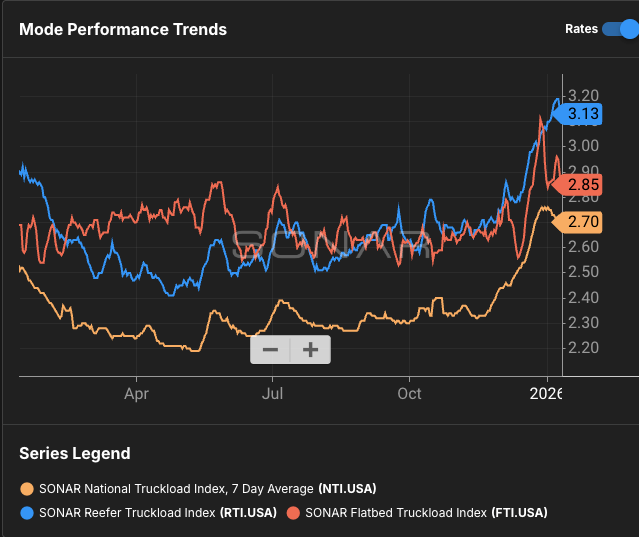
The trucking industry in 2026 is undergoing a significant transformation, characterized by tightening capacity and rising rates. Recent posts from Craig Fuller, CEO of FreightWaves, shared on X (@FreightAlley), highlights how factors such as immigration enforcement, regulatory compliance crackdowns, and driver shortages are sidelining substantial portions of the workforce (sometimes 20-50% in affected fleets) without a matching increase in freight demand. Spot rates have shown upward momentum, climbing through the late-2025 holiday season and into early 2026, reaching multi-year highs around $2.75 per mile (per SONAR's National Truckload Index), while contract rates have lagged. This narrowing gap between spot and contract pricing is forcing carriers to reject unprofitable contracted loads, pushing more freight into the spot market where prices are firming amid stagnant volumes and seasonal pressures.
Freightwaves analysis, including discussions of spot rates needing a $0.50–$0.75 per mile increase to align with CPI since 2020 (potentially pushing them toward $3.50 adjusted levels), points to a prolonged capacity crunch. Upcoming FMCSA regulations could further sideline hundreds of thousands of drivers, echoing past cycles but without easy workforce replenishment. Other indices along with Freightwaves data sets signal that the Great Freight Recession has ended or is near its end, with spot rates at their highest since 2022 and rejection rates holding firm above seasonal norms.
This dynamic creates chaos for freight brokers, who often find themselves underwater, unable to cover spot loads profitably while honoring low-rate contracts from softer market periods. Many mid-market brokers face margin erosion, credit risks, and potential failures in this low-volume, high-cost environment. For truckload carriers, however, rising spot rates offer a vital opportunity to restore profitability after years of inflationary pressures outpacing earnings, allowing stronger operators to command premiums as weaker fleets exit.
Yet capitalizing on this surge proves challenging due to a fragmented system. Trucking companies and freight brokers must navigate 10-20 separate customer portals to discover and bid on available spot loads. This manual, time-intensive process—switching between interfaces, monitoring constantly, and submitting bids—limits the volume of opportunities they can pursue effectively. Many miss prime loads simply because bids aren't placed quickly enough or in sufficient quantity. To scale, operators often resort to hiring large teams for round-the-clock portal management, driving up labor costs and introducing inefficiencies in an already volatile market.
Manifold addresses this fragmentation by consolidating all those disparate opportunities into a single, unified dashboard. Users can view, manage, and bid on loads from multiple portals without endless logins. Its automated bidding feature places offers moments after new loads appear, even overnight or during off-hours,ensuring no opportunities are lost to timing. Beyond execution, Manifold delivers full visibility: track every bid in real time, analyze which rates are winning, and uncover market insights to optimize strategies. For trucking companies, this maximizes hauls and revenue; for brokers, it accelerates revenue growth while slashing overhead.
Ready to experience the Manifold difference? Schedule a demo with our team today!
